Agriculture
Soil, microclimate, irrigation and greenhouses.
Relate crop conditions to applied water and equipment operation.
Explore connected agriculture
Internet of Things · Connected systems
Sensors, connectivity and software to put operations in context. We begin with agriculture and extend this approach to water, industry, energy and infrastructure.
Observe first. Then interpret. Automate only with defined criteria and controls.
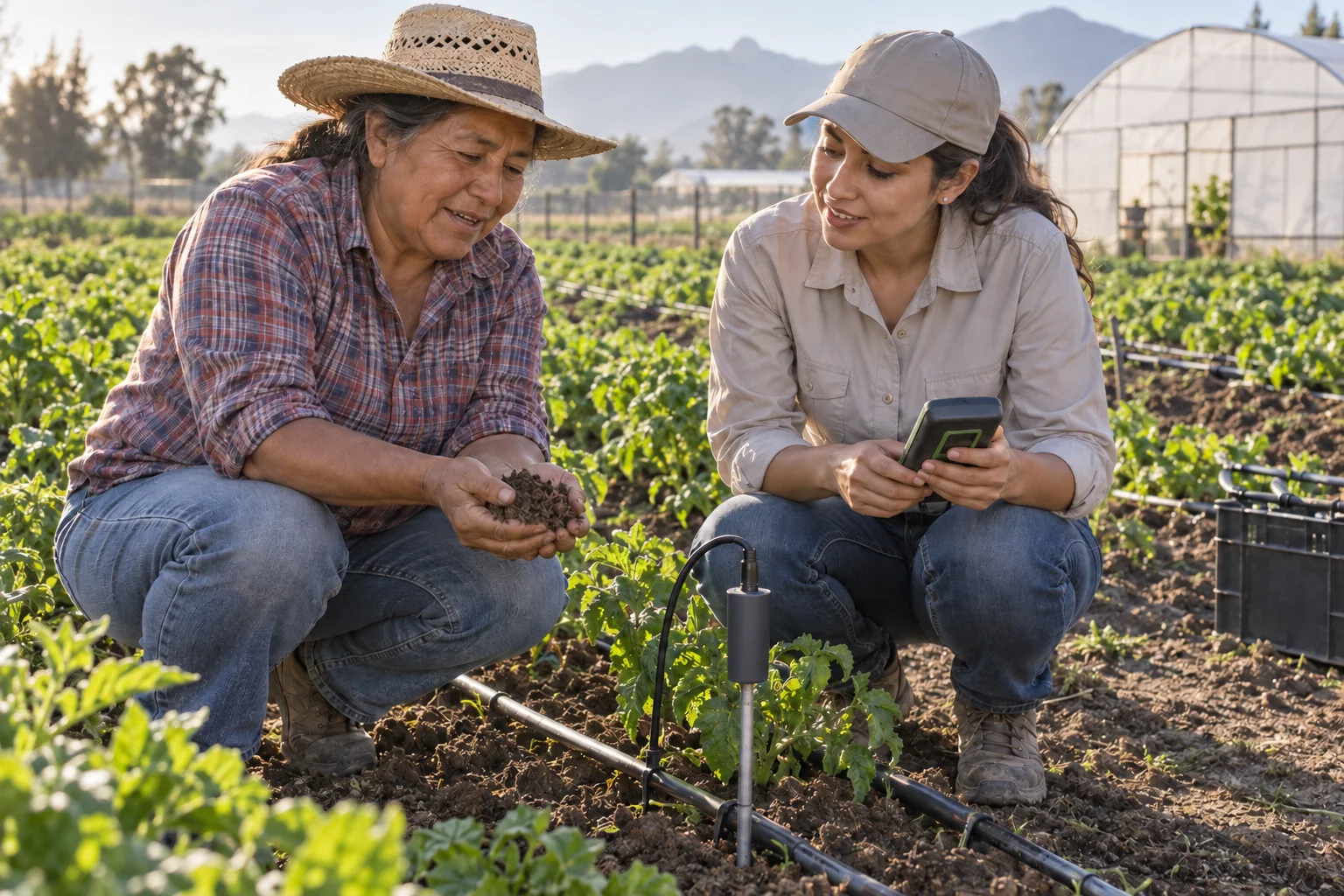
Moisture at different depths helps interpret the root zone. Installation and calibration depend on the soil and crop.
People + technology
Sensors provide signals. People provide context, experience and judgment for decisions.
Illustrative scenes of our capabilities; they do not depict the team, clients or real installations.
Discuss an IoT projectApplication areas
Architecture follows operations: what to measure, who decides and what may happen if a signal fails.
Soil, microclimate, irrigation and greenhouses.
Relate crop conditions to applied water and equipment operation.
Explore connected agricultureLevels, flow, pressure and pumping.
Observe tanks and networks. Quality measurements require specific instruments.
Assess this applicationAsset condition and operational events.
Explore temperature, vibration and available signals to support maintenance.
Assess this applicationConsumption, demand and generation.
Integrate energy measurements; connect with Solar Engine when the equipment is compatible.
Assess this application Discover Solar EngineCold chain and traceability.
Connect temperature, humidity, location and events according to the cargo and operation.
Assess this applicationEnvironment, leaks and remote equipment.
Gain context from technical rooms and distributed facilities while maintaining access control.
Assess this applicationApplications to explore in an assessment. Scope, equipment, coverage and support are confirmed for each project.
From data to operations
The path depends on the site. Not every installation needs the same connection, a gateway or cloud services.
Soil, weather, water and equipment. Instrumentation suited to what needs to be observed.
Validation and temporary storage. Local rules only when included in scope.
Local network, LoRaWAN or cellular connection according to coverage, power and requirements.
History, data quality, roles and alerts. Never confuse an old signal with a current reading.
An informed decision. Remote control only when integrated, authorized and validated.
A solution that works with the rest of your system.
Connectivity ↗Satellite monitoring ↗Software ↗Cyber defense ↗Pilot before scaling
A project must demonstrate that its data is useful for operations. Equipment, maintenance, responsibilities and acceptance criteria are agreed before installation.
Problem, site, coverage, power and the people who will operate the system.
Select and install relevant measurement points, with calibration and defined limits.
Assess continuity, data quality and the usefulness of alerts over an agreed period.
Review results and decide what to retain, correct or expand. No promised savings percentages.
Coverage, power and the required measurement frequency are assessed first. Local storage and different connections can be considered; coverage is not promised without a site assessment.
That is a separate scope from monitoring. It requires compatible equipment, permissions, safeguards, manual control, and technical and agronomic validation where applicable. This page's demonstration does not actuate equipment.
Application, municipality or region, approximate scale and priority problem. For agriculture, include the crop and irrigation system. Do not include passwords, precise coordinates or confidential documents in the first contact.
Ownership, access, export, retention, sensor maintenance and support must be agreed for the project. The operational environment is designed separately from this commercial website.
Let's talk
Share your starting point. Let's define what to measure, which decision to support and how to assess an initial pilot.
Start an IoT assessment